NewSchool of Architecture & Design

Check out our Design & Build Summer Intensive Program for Ages 14-17 here!

DesignMind: Why Failures Are More Interesting than Successes

DesignMind: Why Failures Are More Interesting than Successes

Why Failures Are More Interesting than Successes

San Diego’s annual Orchids & Onions event gives us an instructive opportunity to have a conversation about both successes and what we can learn from our failures

I’m proud that NewSchool of Architecture & Design is a title sponsor of this year’s Orchids & Onions. The event serves a special purpose. Because members of the public nominate projects as successes or failures (Orchids or Onions), it raises the awareness of quality design for the whole community. Its courage to hand out Onions also makes it different. It puts the misses on the table for discussion.

One of America’s founding fathers, Benjamin Franklin, noted that failure was a far more interesting subject than success. There can be no doubt about the legacy he left us for risk taking and innovation.

It is a basic premise of design thinking that there will be more failures than successes. From failures, you can make progress. The same thing can be said of the Onions. There may be parts of a project that are done quite well, but maybe the building just doesn’t fit in its context. Maybe it’s the wrong material; for example glass and steel in a historic district. Maybe the scale is off. It may have merit but have things that get in the way of its success. Perhaps it is so focused on artistic expression that it turns the people who live or work there into players on the palette of someone else’s artwork. Any of these can prompt a discussion about what works and what doesn’t. It benefits designers and architects, and it benefits the community.

Mistakes create the opportunity to raise questions about what could have been done. For a long time, people shied away from failure as a topic, but innovation and entrepreneurship have as much to do with failures as they do with success. Design advances because of failure. Success causes designers to lock in on a way of doing things, while failure requires more thought. Every designer or inventor will tell you that failure is very instructive. Mature discussion is the best way to deal with success and with failure.

In the classroom, failure is discussed all the time. When students are in studio, they start to see and be critical about those things that may not work. Sometimes they are surprised that case studies of projects that don’t work are actually by very well-known architects. In this way, they start to develop their critical eye. One of the toughest environments to walk into is the studio because they are taught to be critical, incisive, and honest so that they aren’t repeating mistakes over and over again. We use success and failure balancing against each other to teach critical thinking.

That said, I am pleased that all of the projects from NewSchool faculty and alumni are Orchids. They reflect very well on our school and speak to what we teach here, which is to be good design practitioners. These projects do an excellent job of building on the successes, and failures, which came before them.

DesignMind: NewSchool is “Green. By Design.”

Sustainability is one of the pillars of our curriculum. We teach our students, especially those in the design, architecture, and masters in construction management online, that everything they design, from clothing to furniture to buildings, as well as how those buildings are constructed, must make efficient use of resources. Sustainability is a fundamental and essential aspect of practice, another pillar of our curriculum.

Great designers are acutely aware of resources. It affects every aspect of their lives: It’s the coffee cup they use, the car they drive, the structures they design, and how they respect the environment and the people who live and work and worship there. I often tell students that design isn’t something you stop and start in your life. Design is your life. Sustainability has to join that circle of who you are. When you think about where we live and the resources we have, we are at a moment in time when we have to learn to use these resources in a much better way.

Our new “Green. By Design.” initiative challenges us to be sustainable across the board. It reminds us to ask ourselves, Do I really need to print this out? Is this the best way to commute to campus? Can someone else in the Materials Lab use the scrap from my project? Should the structure I’m designing have a building envelope that will require less energy?

“Green. By Design.” is also a reminder that great things happen when we partner with our students. The idea and the drive behind it come from collaboration between our Student Life office and our Student Council. They identified this way to connect our mission to our daily campus routines. One of our first actions will be to eliminate disposable cups by giving students bottles and mugs they can reuse. This may seem like a small effort, but we use 60,000 cups a year—enough to encircle our building 19 times!

There are many areas where we can conserve the use of resources. Share your suggestions with me in the comments.

Careers in Design: A Unique Approach

Careers in Design: President’s Blog

A Different Approach to Preparing for a Career in Design

Design professions are changing rapidly. There are many new roles and career paths for architects and designers—from innovation managers in large corporations to directors of energy management and designers of user experience—all the way to traditional roles of creating designs for products and buildings.

Because of this, our goal at NewSchool of Architecture & Design is not only to train students to succeed in a designer job, but also to prepare them to change with the profession over time. They need to know how to think and how to evolve in a career in design . I don’t want a client or employer to look at the work of our alumni and say that person graduated in the ’80s, ’90s or mid-teens. I want someone to look at their design portfolio and say “that person is a really good thinker.”

Having a DesignMindTM is the foundation for that. Being agile and able to move with the profession—not just the advances in technology but societal attitudes and the role of design in culture. That’s our challenge: To find the balance between training and career preparation and preparing students for lifelong learning.

One way we do that is through our faculty. At a typical design program, about 85 percent of the faculty is full time and they do 90 percent of their work inside the university setting. Only about 15 percent are practitioners. That ratio is reversed at NewSchool. Whether you want to learn how to become an interior designer or a construction manager, our faculty is made up mostly of current practitioners who work in product development, construction management, architecture, and other related fields. Our students have very immediate, hands-on relationships with people who are practicing what they teach.

Another way we do this is through the global influence on our degree programs. It is impossible not to be touched by the international design community, and designers must work cross-culturally. For example, one of the finalists to design the Obama library in Chicago is David Adjaye, who was born in Tanzania and has offices in London and New York.

We have a tremendous advantage in this regard because we are 12 miles from an international border and have strong design program and Global Design Degree with our sister school in Milan, Italy, Domus Academy. The Domus Academy School of Design at NewSchool of Architecture & Design gives students access to a truly global classroom. In addition, through our vast network of study abroad opportunities, our students are able to view the world with an eye toward multiculturalism. Right now we have two exchange students from Madrid and 16 of our students are in Milan for the spring quarter. A global conversation is part of life at NewSchool.

What students learn from our degree programs here in San Diego and abroad, with our practitioner faculty and those in other parts of the world, will contribute to their DesignMind and their preparation for career success.

What do you think contributes most to career success in design?

DesignMind: Why You Should Visit NewSchool in Person or Virtually

Why You Should Visit NewSchool in Person or Virtually

We have an Open House Aug. 5 and a new self-guided virtual tour you can take in English, Spanish, or Arabic.

Whether you’re looking to get your masters in construction management or degree in architecture, there are many factors that contribute to your decision about which school to attend: program selection, faculty expertise, internship options, accreditation, cost, location. I remember them well from when my daughter was choosing a college (even though that was more than a decade ago), and they are front of mind for me when I talk with prospective students and their families.

Once you’ve sorted through those considerations, you need to visit the school. You need to touch it. You need to see if it feels right to you. You have to find the place that suits your personality. When I was visiting colleges with my daughter, I would turn her loose and stay in the background. I gave her the same advice that I give to all students thinking about studying architecture: In the studio, when the lights are out except for the one over your drafting table and everybody else is gone and you’re having a hard time solving your problem, that’s the moment in time when you have to say “I chose this school.”

Our Open House on August 5 is a perfect chance to experience NewSchool that way. You’ll get an interactive tour. You’ll visit the studio space and materials lab. You’ll speak with students about their experiences and see the work they’ve created. And you’ll get great advice about where to live and how to afford school.

You can also visit NewSchool for a personal tour, but we know that’s not possible for everyone—especially our international students. That’s why we recently created a virtual tour that combines 360-degree views, photos, videos, and narration from our online tour guides in English, Spanish, or Arabic. You can’t get any closer to NewSchool without actually being here. I wish other schools had this option when my daughter and I were driving across country visiting colleges.

President Marvin Malecha and Director Elena Pacenti to Attend Design Forward > San Diego

Design Forward > San Diego will take place on Thursday, June 16th at the Port Pavilion on Broadway Pier in San Diego, California. NewsSchool of Architecture and Design and Domus Academy School of Design have partnered with this all-day design summit bringing together more than 1000 industry innovators, civic leaders and designers to look at the potential and the power human-centered design has in driving the economic growth and global identity of San Diego. NewSchool President Marvin Malecha and Domus Academy School of Design Director Elena Pacenti will be in attendance to engage with attendees and highlight the innovative work being completed at NewSchool and Domus Academy.

Elena will also be among the many speakers at Design Forward > San Diego participating in the panel discussion “Creating Value Through Design” taking place from 10:00 to 11:00 a.m. The discussion will be centered around how cities in the U.S. and around the world are embracing design and how San Diego can learn from these other cities on how to use design to grow its economy. The panel of experts will be moderated by Joan Gregor, Intersection-Inc. and will also include Peter Haythornthwaite, Better By Design & Design to Business (NZ/Australia), Gabriella Gomez-Mont, El Laboratorio para la ciudad de México (Mexico City) and Victor Nacif, London, the Design Council, (United Kingdom).

Along with her panel discussion, Elena will also co-lead a morning salon, “What is Design?” This interactive salon will look to provide comprehensible explanations of the design profession’s processes, definitions, applications and language. Lead by Chad Martin, Senior Product Designer, hp & UX Speakeasy, other co-leads include Paul Hong, Founding President, SDXD and Rohit Kapoor, Design Strategist, SAP.

Additionally, under the guidance of Domus Academy Interior Architecture faculty members Marianne Berg and Valentina Bertolizio, sophomore and junior year Interior Architecture & Design students worked together on the design of the interiors for the conference venue. For more information on Design Forward > San Diego and to purchase tickets please visit: https://designforwardsd.com/#about

DesignMind: The Importance of Napkin Sketches

Architects and designers are creative beings who can easily find inspiration at any moment. A napkin sketch is an elemental expression of thought. Napkin sketches have been a go-to companion for those who find spur of the moment inspiration allowing for the exploration of thoughts and ideas with their hands. You can express primal feelings, a memory, even a philosophy. It’s a telling exercise about how people think, what is important to them, and the spirit of their thoughts. These little pieces of paper displaying ideas can eventually be turned into greater works of art.

For the fifth year in a row, our chapter of the American Institute of Architecture Students has put together a wonderful Napkin Sketch Auction for Friday, June 10. It’s a way for students to raise money for their activities, use their leadership skills to organize something special for the school, and contribute to our school spirit.

This event began as a “sketch for a sketch” project where our students crafted their own napkin sketches to capture the attention of well-known architects. These creations are then mailed to architects from around the world with a request for an original sketch that can be auctioned off during the event. This year students have received napkin sketches from more than 20 prominent architects. It’s a reminder that in an age of computer-aided design, these individuals still value the art of thinking visually and drawing by hand. Their sketches also demonstrate that good architects are also good communicators. They use sketches not only for self-reflection and self-thought, but also as communication.

I was particularly inspired and contributed five sketches. Let me tell you a little about them.


This drawing of a tree is the first napkin sketch I did for the auction. It shows the tree not just above ground, but below, associating the strength of the tree with the strength of the root structure beneath it. For a tree—and for creativity—to flower, it must depend on the foundation below it. Great ideas require deep roots.

Serious thought is informed by folly, which is what I was exploring with the structure on a beach.

When I was being interviewed by the Union-Tribune, reporter Roger Showley asked me if our students would work on concepts for a border wall. My response was that the first question a great designer asks is why, why are you doing this? Building a wall is really an exercise that does all the wrong things. Instead of sketching a wall, I sketched a beacon for our harbor.

My fourth napkin sketch is philosophical. It represents the circle of life from the cave house to the cloud house with the six orientations—north, west, east, south, up, and down—that connect us with the architecture and the land as a mediator. This sketch connects Western, Eastern, and Native American theology with an environmentally sensitive architectural and design philosophy.

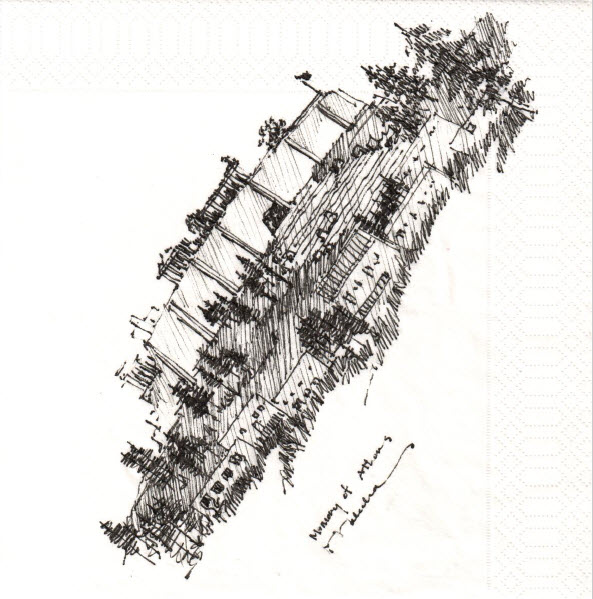
My final napkin sketch is about memory. The last time I was in Athens, I stayed at a hotel with a spectacular view of the Acropolis and I spent several hours sketching it. The napkin is a memory of the Acropolis and that experience.

What are you sketching?

At NewSchool of Architecture & Design, we offer a wide range of degrees in architecture, design, and construction management. Contact our Enrollment Team today to learn about a degree program for you.

President’s Blog: The Rise of DesignMind in San Diego

I first came to San Diego in the summer of ’77. I remember being at the old Santa Fe Terminal thinking this seemed like a town living in the shadows of San Francisco and Los Angeles. In the years since, and especially in the last decade, San Diego has transformed itself in an amazing way. Now I see a unique city attracting companies from around the world with a burgeoning creative class. San Diego is accomplishing this by embracing design culture and design thinking. San Diego has a DesignMind (TM).

A DesignMind opens the door to innovation. It’s what stimulates companies to grow and products to evolve. Throughout American history, there are many heroes who had a DesignMind, from early thinkers Thomas Jefferson and Benjamin Franklin to Thomas Edison, Henry Ford, Walt Disney, and Steve Jobs. Their innovation edge has made American industry and culture agile and vital.

At NewSchool of Architecture & Design, our students are developing their own DesignMind. Their free inquiry, critical thinking and global mindset are critical to their future and the future of our cities. We make this possible not only by operating in a dynamic city, but also by operating in a new model of higher education.

I have been fortunate to live a design life as an architect, designer, educator, and leader. Now, I’m fortunate to be back in a renewed San Diego guiding and chronicling the developing DesignMind of our students, faculty, city and region.

What does the concept of DesignMind mean to you?

NewSchool President Marvin J. Malecha to Speak at AIA Convention

Media Contact:

Rachael Lighty
rlighty@newschoolarch.edu
1-619-684-8775

NewSchool of Architecture & Design President Marvin J. Malecha to Speak at American Institute of Architects Convention

SAN DIEGO, CA and PHILADELPHIA, PA – May 18, 2016—NewSchool of Architecture & Design (NewSchool) today announced that President and Chief Academic Officer, Marvin J. Malecha will be participating in a panel discussion at The 2016 American Institute of Architects (AIA) convention, one of the largest annual gatherings of architects and design professionals in the nation, taking place May 19-21 in Philadelphia, Pennsylvania. The panel entitled: “Path to Licensure/Next Generation” is scheduled for Friday, May 20 from 2:30 to 3:00 p.m. ET and will focus on the Integrated Path to Architectural Licensure (IPAL). President Malecha will be joined in discussion by Michael J. Armstrong, Chief Executive Officer, NCARB; Michael K. Monti, Hon. AIA, Executive Director, ACSA; and Andrea Rutledge, Executive Director, NAAB.

The IPAL initiative, created by the National Council of Architectural Registration Boards (NCARB), presents students with the essential requirements of education, work and experience to attain licensure before graduation. In December, NewSchool was one of the first 13 accredited architectural programs accepted for participation in the program. This pathway at NewSchool will help decrease time to architectural licensure for students who complete all IPAL program requirements.

In addition to his panel discussion, President Malecha will be available with fellow NewSchool alumni for a meet and greet Thursday, May 19 from 6 to 8 p.m. at The Sheward Partnership in Philadelphia.

The agenda for the AIA Convention features presentations and panel discussions by industry leaders as well as more than 800 exhibitors showcasing the latest technology and trends. This year’s theme, IMAGINE+, focuses on the ability to innovate, collaborate and apply imaginations. When this is completed in the context of specific goals and dreams, real change can be achieved. For more information on the convention and to register to attend President Malecha’s discussion visit: https://convention.aia.org/Attendee/ShowInfo

About NewSchool of Architecture & Design:

Located in downtown San Diego, NewSchool prepares students for career success in design fields through an emphasis on interdisciplinary and global design skills, industry collaborations and real-world projects. Programs of study include architecture, construction management, product design, media design, game development, and interior architecture & design. The school’s design environment provides inspiration for the school’s students and faculty, recognized for their work regionally and internationally. NewSchool is accredited by the Western Association of Schools and Colleges (WASC) Senior College and University Commission. NewSchool’s Bachelor of Architecture, Master of Architecture and Executive Master of Architecture programs are accredited by the National Architectural Accrediting Board (NAAB). NewSchool is a member of the Laureate International Universities network – a global network of more than 80 campus-based and online universities in 28 countries.Through this network, students at NewSchool are prepared to work in a global and diverse work environment through the school’s collaborations with sister institutions in the Laureate network, including award-winning schools such as Domus Academy in Milan, Italy. For more information about Laureate International Universities, visit www.laureate.net.

ARCHITECT Magazine Discusses the Vision for NewSchool with President Marvin J. Malecha

ARCHITECT Magazine recently spoke with NewSchool President Marvin J. Malecha to discuss his vision for the university and the future of the architecture and design profession.

In the Q&A, President Malecha speaks to his goals for his new position; what inspires his passion for architecture and architectural and design education; how the scope of architectural education has changed throughout the course of his career, including a shift in student diversity; and why the new ways of practicing the profession has changed the way the discipline is taught.

To read the full interview, visit https://www.architectmagazine.com/practice/q-a-marvin-malecha-on-architecture-and-architectural-education_o

Renowned Architect, Global Design Leader Marvin J. Malecha Named President & Chief Academic Officer

NewSchool of Architecture & Design Names Renowned Architect and Global Design Leader, Marvin J. Malecha, as President and Chief Academic Officer

Malecha, former Dean of the College of Design at North Carolina State University, brings more than 40 years of experience and excellence in academia, architecture and global design education and thinking

Media Contacts:

Lauren McDaniel

lmcdaniel@newschoolarch.edu

1-619-684-8775

Rachael Lighty

media@newschoolarch.edu

1-410-218-6055

SAN DIEGO—January 11, 2016NewSchool of Architecture & Design (NewSchool) is pleased to announce that world-renowned architect and global design educator Marvin J. Malecha, FAIA, has been named President and Chief Academic Officer, effective Jan. 1, 2016. Malecha, who most recently served as the Dean of the College of Design and Professor of Architecture at North Carolina State University, has more than 40 years of experience in academic leadership, architecture and global design education. Since 2010, he served as an important member of the NewSchool Board of Directors.

“President Marvin Malecha has long been an advocate of NewSchool of Architecture & Design, and as a Board member, he has been deeply committed to our mission and the success of our students, faculty, and alumni,” said Vivian Sanchez, Interim President and Chair, NewSchool Board of Directors. “As a highly awarded architect and educational leader, President Malecha’s proven transformational leadership has instilled our confidence in his ability to guide NewSchool as we fulfill our ambitious plans for innovation in global design education and continued academic excellence. President Malecha brings a strong vision that will propel NewSchool forward as a leading global design institution.”

Malecha served as the Dean of the College of Design for North Carolina State from 1994 until December 2015, and for 12 years prior, was Dean of the College of Environmental Design at California State Polytechnic University, Pomona.

“I am eager to join NewSchool of Architecture & Design in this leadership capacity and look forward to fostering an environment where design-thinking is considered essential language of the creative discipline,” said President Marvin Malecha. “As an intimate, tight-knit university community, I’ve witnessed how NewSchool has a certain agility, which is critical during a time when design and innovation are all about agility. The faculty and students here have a thirst to push design in new directions and to innovate.

San Diego itself is an emerging new urban center that’s truly unique and an interesting mix of high-tech, high education and research, paired with a young population that’s remaking the image of the city. I see a real convergence of energy here and look forward to pushing open the doors so practitioners and instructors can collaborate freely in discourse, connecting students with the practice of their discipline and broadening their perspectives.”

Malecha is a highly awarded architect, thought leader and academic innovator, and has received the Excellence in Education Award from the American Institute of Architects (AIA), California Council and the National Council of Architectural Registration Boards’ Prize for Creative Integration of Practice and Education in the Academy. Malecha was ranked second nationally in 2005 for his influence on practice among architectural educators in the U.S. by Design Intelligence magazine and in 2006 the magazine named him Architectural Educator of the Year.

He is the only American educator to have been recognized as an honorary member of the European Association for Architectural Education and was also named Distinguished Professor by the Association of Collegiate Schools of Architecture (ACSA) in 2002 for creative achievement in the advancement of architectural education through teaching, design scholarship, research or service. He received the prestigious 2003 Topaz Medallion for Excellence in Architectural Education from the AIA and ACSA and, in 2006, was inducted into Sigma Xi, the scientific research society.

As an educator, Malecha has devoted considerable energy to international studies and integrating a global view in architectural and design academic programs. He has conducted seminars and lectures at universities abroad including in Belgium, Chile, Italy, Japan, Korea, Romania, and Spain, and recently conducted lectures and seminars in Antwerp, Belgium and Santiago, Chile, as well as in Bucharest, Romania, where he was presented with an honorary degree, the Professor Honoris Causa. Malecha founded a bi-annual conference between the Architecture Research Centers Consortium and the European Association of Architectural Educators (EAAE). He was recognized as the 1980 Rotch Traveling Scholar, a prestigious honor, established in 1883 and bestowed annually to a top scholar, allowing them to travel the world, documenting the experience in images, drawings and text. In addition to Malecha, the roster of Rotch Scholars includes many of the country’s most distinguished architects.

Malecha earned a Bachelor of Architecture from the University of Minnesota and a Master of Architecture from Harvard University. He has served on the National Architectural Accrediting Board, is a member of the California Council of Architectural Education, a Fellow in the AIA and has served as President of the Association of Collegiate Schools of Architecture (ACSA). Malecha also previously served as the Vice Chair of the AIA/ACSA Council on Architectural Research and as First President/President Elect (2008-2009) of the AIA. He also served AIA as the National President in 2009. Malecha is a published author, and his most recent book, Being Creative: Being a Creative (Kendall Hunt Publishing, 2015), published this past June.

“I am excited and energized for the future of both NewSchool and of design education,” said Malecha. “It’s one of my goals to promote that design is a continuum, and we as educators are setting students on the path to be always learning and always innovating.”

To read Malecha’s full biography, visit newschoolarch.edu/about/meet-our-president/. For more information on NewSchool, visit newschoolarch.edu.

*