NewSchool of Architecture & Design

Check out our Design & Build Summer Intensive Program for Ages 14-17 here!

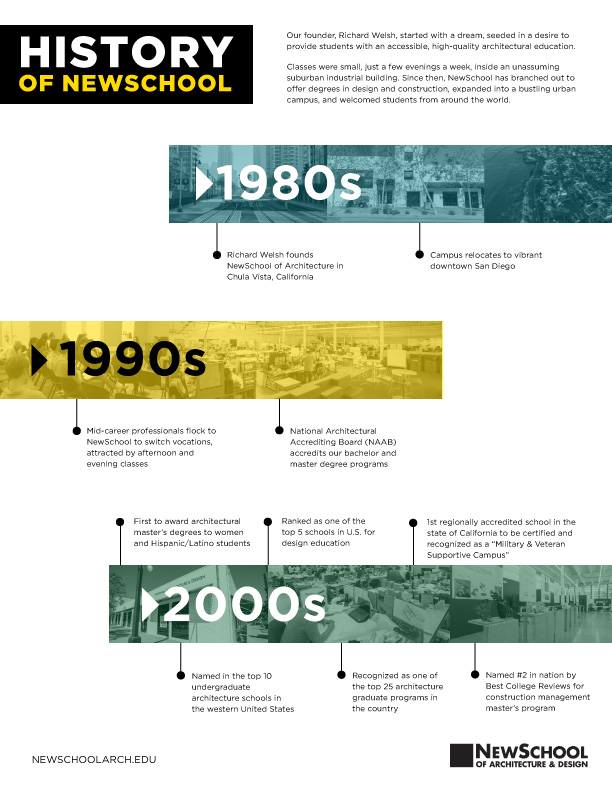
NewSchool’s History is Rooted in Innovation

Evolution of Product Design in a Digital Age

Evolution of Product Design in a Digital Age

It’s no secret that product design is a booming industry. With more and more people buying and using products, physical and digital, companies are looking for skilled designers to create beautiful and user-friendly experiences.

The scope of Product Design has evolved.

It’s not just about designing industrial products for manufacturing industries, anymore, but it is about designing complete experiences with elaborated systems, made of objects and information. As the world of products evolved into digital realms, there are many other industries that require design skills and innovative solutions.

“It wasn’t that long ago where we we lived in an almost exclusively physical environment, where we’re going longer term is where you start introducing hybridity, where there’s a very intimate relationship between digital technology and being a human being.”

– John Bandringa, Product Design Faculty, NewSchool of Architecture and Design

Diverge Electric Sportfishing Project by Product Design Student, Chad Skelton

The product design role is much more than drawing pretty pictures.

Designing a truly personalized experience involves customer insights, and increased understanding of technologies, collaborative processes and intelligent tools.

At the heart of design is envisioning solutions to improve people’s live, and problem solving.  The process of product design is about figuring out real people’s problems and then solving them for the best possible user experience. Countless hours and days are spent coming up with innovative designs and concepts.

 “I think there is an awakening in the U.S. in this field and a better understanding that ethical design is good business. Creating an experience that does not manipulate a user but actually enhances their well-being.”

-Tiziana d’Agostino, Experience Design Faculty, NewSchool of Architecture and Design

It’s clear that without special knowledge it can be very difficult executing a successful product; but these days there’s so much more than just essential; it combines user experience (UX) and customer research skills to create a broader position as technology pushes its boundaries enabling the expansion of design.

As companies grow, they will also evolve with technology; it’s essential to understand the role technology will play when it comes to product design. Product design is a role that will be needed in any size business, helping to bridge technological advances with human needs, to observe and understand how the wants and needs of the consumer develop over time, from the local to a global scale.

Designers are an integral part of the success behind every company’s product.

You can be as innovative as you want in the world of product design, working on anything from toothpaste to the next life-changing app, giving you an opportunity to make your ideas come alive. Visual and communication skills and being a team player are characteristics that become essential when applying for jobs in this field. Collaborating with other team members is a great skill to have because you will create and produce innovative items in a group environment.

A product designer can come from any walk of life. What are you passionate about? Do you like to come up with creative ways to solve a problem? Are you a team player? Do you like to brainstorm ideas with other people? A structured learning plan will help guide you and keep you on track. Could product design be right for you?

Choosing a major can be confusing; you are not alone in deciding if Product Design is right for you.

At NewSchool of Architecture and Design, our admissions team will assist you with this exciting career. We are always ready to answer any questions you might have about the enrollment process. Our curriculum combines art, science, and technology to create innovative products and services.

Our students in the product design program learn how to design products and build brand strategies through a solid interdisciplinary foundational year, intensive case studies, and projects collaborating with companies to gain real experience after graduation.

“Studying at NewSchool of Architecture and Design, you’ll be taught the skills needed to be a successful product designer, and you’ll learn from very successful designers in a number of fields with years of experience and first hand knowledge of what is required to be a successful designer.”

– Aaron Ryczek

Not only will you be able to design products that can improve people’s lives, but you also get the chance to work on teams and incorporate other modern technologies into your work. Let us help you become a product designer. We focus on global design education and entry-level practice for our students.

Product Design is expanding in ways that were never possible before, in addition to creating great products that ease the pains of everyday products, we now have a digital universe to accommodate with new innovative ideas.  Let NewSchool take you on your new adventure. Contact our admissions team today.


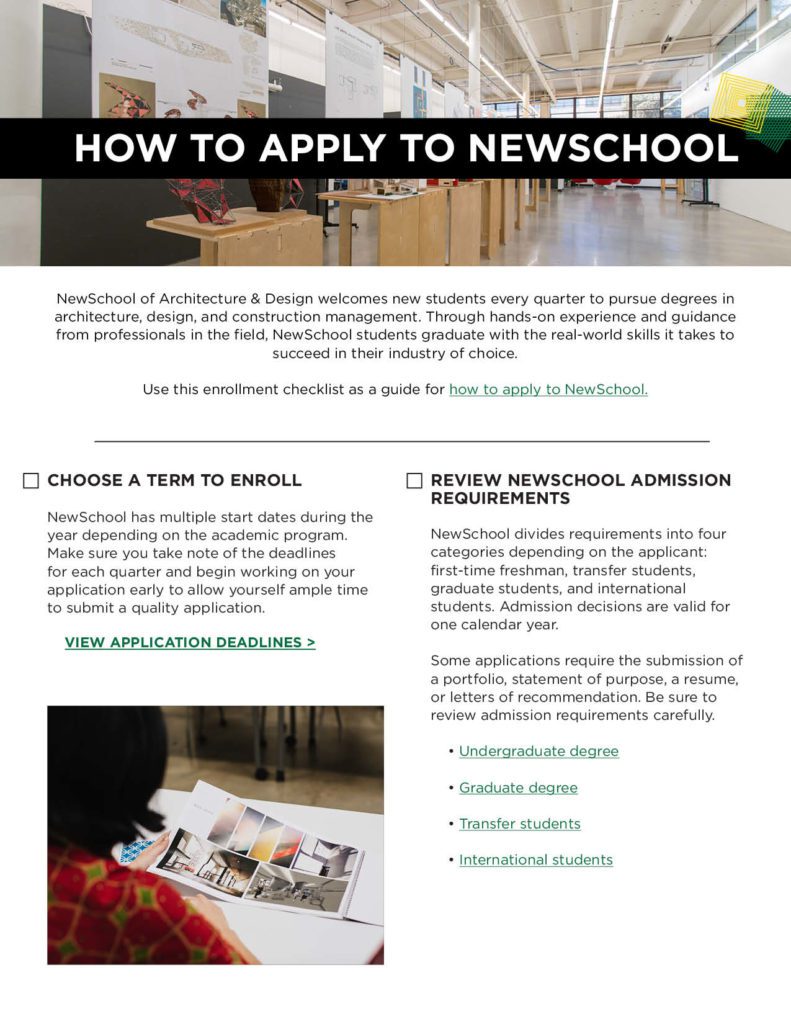
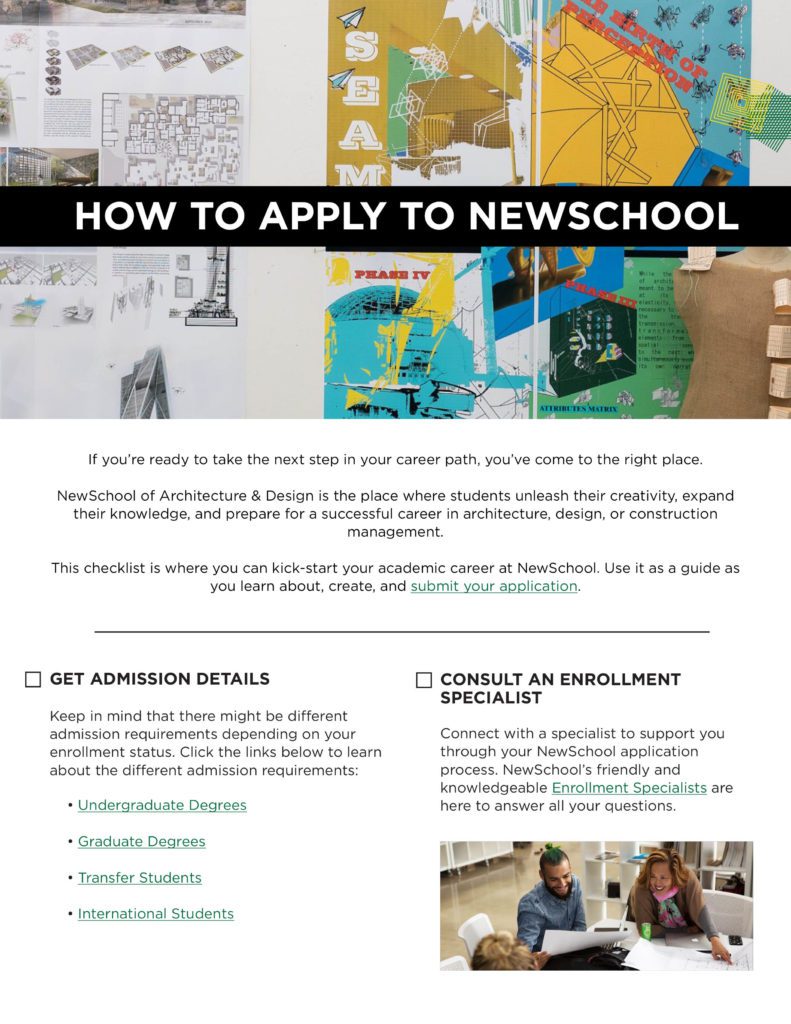
How to Apply to NewSchool of Architecture & Design

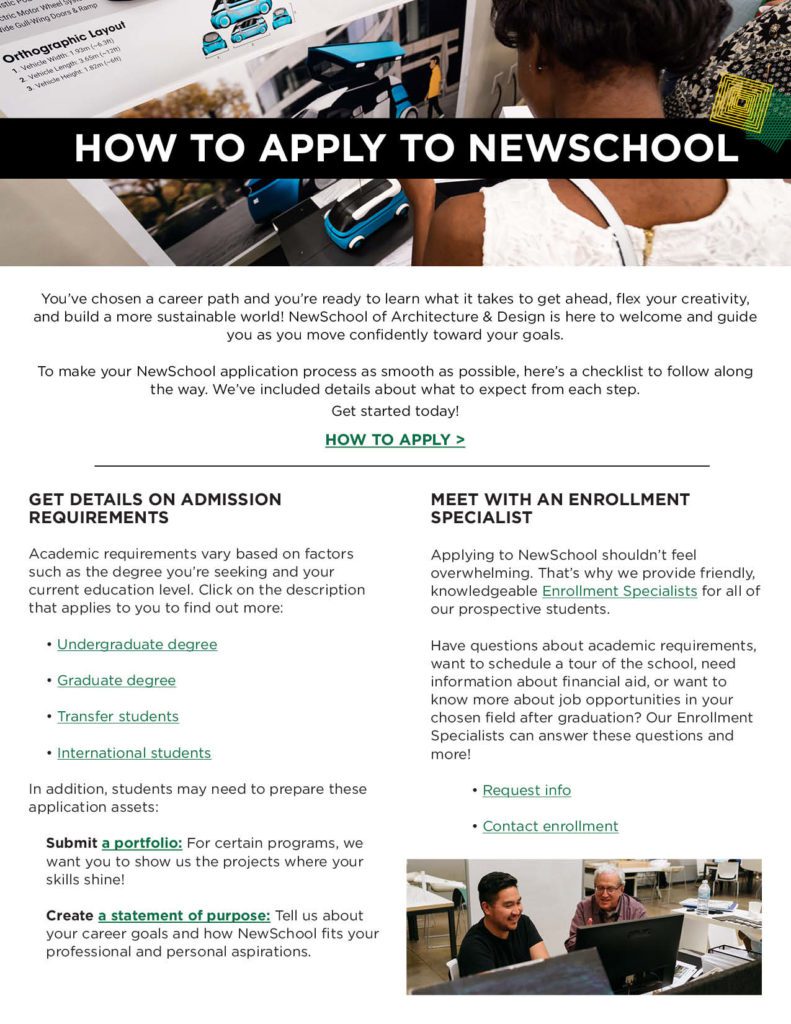
Our team knows that the application process to a college can feel overwhelming, so we want to make sure you have the resources you need to prepare for your future at NewSchool!

We’ve created a handy checklist for prospective students that includes information about application deadlines, architecture portfolio requirements, admission requirements, financial aid, and much more.

Click to View or Download Our Checklist

Checklist on how to apply to NewSchool of Architecture & Design in San Diego, CA.

How to Study Architecture Abroad

Studying architecture abroad sounds great, doesn’t it? You could visit a place you’ve always dreamed of visiting and soak up its culture while you continue your architectural studies. What could be better for an architecture student than that?

The good news is there are plenty of programs available that will allow you to study architecture all around the world. However, there are several things to consider before a student packs their bags. Here’s a look at how to study architecture abroad.

Why You Should Study Abroad

Chances are that when you decided to pursue a career in architecture or obtain your architecture degree, there were designs and architectural practices from all around the world that caught your eye. Whatever your favorite styles, time periods or buildings may be, studying abroad gives you the opportunity to see them in person and learn in their shadows. You’ll find great inspiration in seeing the historical architectural styles around the world as well as the more modern styles that are emerging today.

You’ll also see the impact different styles of architecture can have on a culture. This includes the aesthetics, safety and functionality of a building. This will help you gain a deeper understanding of the architectural field and perhaps even influence your own style that you can take back home with you.

Places To Consider When Studying Architecture Abroad

Once you have the “why,” one of the first things to consider when you’re planning to study abroad is where you would like to go. Start by making a list of the different places with environmental design and buildings or architectural styles that inspire you. After you have your list, you can search each destination to see if a local university offers a study abroad program. Check out NewSchool’s study abroad programs in Italy, Portugal, and Spain—ideal for students pursuing a master’s in architecture who want hands-on exposure to global architectural traditions.

From here, you’ll need to get more specific. What particular focus do you want to study while you are abroad? Of course, studying abroad gives you access to historical architecture and a variety of architectural styles, but also many unique modern styles. Since these categories rarely overlap, you’ll have to choose one.

Popular Countries to Study Architecture

Popular historical cities in which to study abroad include:

  1. Rome, Italy. studying architecture abroad program in Ital In Rome, you can gain inspiration from Rome’s remarkably well-preserved ancient relics. Italy is filled with iconic landmarks and diverse architectural achievements from the leaning Leaning Tower of Pisa to the modern-day skyscrapers in Florence. 
  2. Barcelona, Spain. Barcelona is home to the unique style of renowned Catalan architect, Antoni Gaudi, whose work bridges the gap between the old and new world, as one of his most famous – the Sagrada Familia – is still under construction today, nearly 100 years after his death.
  3. Dubai, United Arab Emirates. If a more modern style intrigues you, there are numerous opportunities in burgeoning modern architecture mecca, Dubia, in the United Arab Emirates, home to the current tallest building in the world, the Burj Khalifa.
  4. Beijing, China. Beijing has many structures that showcase its history, but the city was given a makeover when it hosted the 2008 Olympic games, with buildings featuring eye-catching, asymmetric design.
  5. Australia. studying architecture abroad program in AustraliaThere are also several opportunities available in rapidly-growing Australian cities like Perth, Sydney and Canberra. (Australia also offers the added perk of being an English-speaking nation, eliminating the language barrier you may encounter with other international programs.)
  6. Japan. If it is indeed the rare hybrid program of old and new that you seek, there are some available. You could head to Japan to explore the old Eastern styles, and how they have developed to the earthquake-proof buildings popping up the last 30 or so years.
  7. Chile. In South America, Chile has a wide array of architectural programs that dive into how traditional Chilean style has grown into the modern architecture you will currently find in cities like Valparaiso and Vina del Mar. But these are mere suggestions and you can potentially study anywhere in the world as long as the program offerings match your academic needs.

When Should You Study Abroad?

Arguments can be made for studying abroad at any time during your college years, but since we can assume you have chosen architecture as your major and have presumably begun your coursework, your best bet is to go abroad during your last two years of study and focus on your major requirements. This will slim down your location wish list to your real candidates, as certain programs may only be available during Spring or Fall semesters. This will help you find a program that is best-suited to your needs and interests.

Another option is to study abroad during your summer or winter break, perfect for those who want to squeeze in a quick abroad experience in the midst of your studies. Wherever you choose to go, make sure the credits you earn will be accepted toward your degree, otherwise the “study” portion of your abroad experience will be a waste of time and money. And speaking of money…

How Are You Going To Pay For It?

This is often the deciding factor, as study abroad programs can be quite expensive. There are a multitude of scholarship opportunities, such as architecture and interior design scholarships, available to offer some financial assistance if needed. Do your homework to see if there are any additional financial aid or scholarship programs to help you finance your dream study abroad program.

NewSchool offers amazing study abroad programs for architecture and design. We believe that being exposed to a wide range of cultural design perspectives will make you a stronger and more adaptive designer and architect. Study abroad with NewSchool in Milan, Italy, Porto, Portugal, Compostela, Spain, or Rome, Italy and expand your architectural knowledge!

Media Design Career Paths

With so many professional possibilities to explore as a media designer, it’s no wonder the design career path continues to grow in popularity for undergrads in the digital media arena. From creative jobs in the entertainment and advertising industries to roles in science or healthcare that specialize in communication, there are plenty of media design careers available to the skilled media designer.

What Is the Role of A Media Designer?

As a media designer, your tasks are varied, including a host of multimedia applications. Your primary responsibility involves the communication of information, messages, and/or entertainment through different digital and print mediums.

Anyone who designs and creates using the computer can call themselves a media designer. This includes a design job title such as a graphic designer, web designer, and even animators!

When pursuing your design career path, your role may also entail creating:

  • 2-D and 3-D Images
  • Computer Graphics
  • Models
  • Animations for Film and Video
  • Digital Illustrations
  • Special Effects (depending on the specific area you pursue)

In turn, your designs will be utilized in an array of integrated media platforms, including but not limited to the internet, television, film, and mobile technologies.

Media designers may also find their work featured in more traditional channels, including newspapers, manuals, brochures, and other printed collateral. In general, your role will encompass the design of a visual presentation of some sort, whether it is used for entertainment purposes (such as the film industry), or for product enhancement, where your design skills are being applied as a means of visual communication.

What Skills Do I Need To Become A Media Designer?

For those who are considering a career in media design, it’s important to be aware of the skills and resources, and design degree needed to succeed. A fluency in computer software and coding is essential, as well as an intermediate/advanced level of proficiency in both Windows and Mac computer systems.

If you’re exploring a career in interactive web design, a working knowledge of programming languages is fundamental for your career development. These languages include:

  • HTML (Hypertext Markup Language)
  • XHTML (Extensible Hypertext Markup Language)
  • CSS (Cascading Style Sheets)

Because nearly all web-based animation is created using Adobe Flash, you will want to become familiar with this program.

In addition, becoming adept at both Adobe Illustrator and Photoshop is key for anyone pursuing a career in the digital media arts. In addition to a high aptitude in computer technology and software, your creative, artistic, communication and organizational skills are crucial to your professional success once you enter the workforce.

In order to determine if a career path in media design is the right fit for you, here are a list of pros and cons:

PROS of a Career in Media Design:

  • Digital media careers allow for creative expression
  • Your work may be seen by a large audience
  • There are vast opportunities for advancement and growth within your field
  • BLS statistics show that web design and related fields will see an increase in growth within the next ten years

CONS of a Career in Media Design:

  • A demanding schedule including deadlines can be stressful
  • If you’re a freelance designer, you must find your own work and maintain a steady flow of clients to remain financially stable
  • In order to be successful (as a freelancer or full-time staff member), your schedule must cater to the client
  • Because software and technology are constantly changing, you must remain up-to-date and constantly abreast of trends & tools within your industry

How To Become A Media Designer

If you’re interested in pursuing a profession as a media designer, there are several ways of obtaining your goal. Many undergrads choose to earn their bachelor’s degree in animation or graphic design.

  • Proof of Completing High School

In order to proceed, you’ll first need to have a high school diploma or equivalent before applying to colleges of your choice. 

Keep in mind that students should take classes in art history, drawing, graphic arts, and/or web design. Working on school newspapers or yearbook can help showcase your web design skills.

  • Apply to Colleges

Once you’ve been accepted, your coursework will focus on image design and manipulation, web design and website maintenance, 3-D modeling, and digital video editing, as well as other computer software programs and digital tools.

  • Internships and Experience

Additionally, those enrolled in a bachelor’s degree program can expect a combination of specialized classes and real-life, hands-on experiences to prepare them for client design thinking and for the design industry  job market, including internships or similar opportunities.

In some instances, your bachelor’s program may require a senior project, which can be used later on within your portfolio as a representation of your work.

  • Build Portfolio

In addition to becoming an expert in your field, building a strong portfolio during your college years is imperative for your post-grad job search and to reaching your career goals.

  • Master’s Degree

For those who wish to seek a higher salary range and further their education, there are also master’s degree programs in graphic design, digital media, and animation.

Looking Ahead: Job Forecast For Media Designers

Similar to those pursuing masters in Construction Management online, it should be noted that there is no shortage of job opportunities for those seeking employment within the media design profession. Due to the booming demands of our digital age, there are positions within the animation, film, television, web, mobile technology, and video game industries.

According to the U.S. Bureau of Labor Statistics (BLS), the digital media design industry is expected to experience an on-average job increase from 2014-2024. Computer graphic positions can anticipate growth within the expanding mobile technology market, while the consumer demand for movies, video games, special effects and 3-D animation are also accountable for some of the projected growth within the job forecast.

Additionally, research has shown that employment may also be sought in alternative areas, such as law, medicine, science, architecture and business, where media designers assist in the enhancement of products and modes of communication within said industries.

It is also anticipated that between 2014-2024, employment for all art and design workers in the business industry, and media or architecture career professions can expect a growth rate of 2%. Statistics show that the stagnation in employment growth within the industry was largely in part due to companies hiring labor from outside of the US.

To Pro-jèct

By Elena Pacenti, Ph.D.
Dean, School of Design

In October 2019, I was invited to give a key-note speech at the 4D Conference in Osaka, Japan in front of an international audience of designers and design experts.

During the preparation of my speech, I had the opportunity to reflect on the very nature of design and its meaning concerning contemporary challenges.

We live in very particular times, in which the progression of technology is faster than ever before, and at the same time, the natural resources of the planet have shown their limits.

As designers, we have the unique opportunity to contribute to the creation of the next generation of products and systems, a fundamental role in humanizing technologies and the responsibility of envisioning a sustainable future.

In my presentation, I investigated the actual meaning, value and substance of design and proposed to explore the notion of design as pro-jèct – in Italian progettare, in French projecter, from Latin projectare – to redefine and clarify what I believe are the core competences of design as a profession across different specializations, disciplines, scales and product types.

The idea of project as a verb, derived from the etymological roots pro-jacere – to throw or cast forward’ – challenges the universally accepted notion of design as problem-solving and as a process that can be applied to deliver a solution to a given problem, and argues that the substance of design is the ability to envision and to create hypothesis (give birth to possibilities, opportunities) that are not given, nor yet exist.

The problems to be solved have yet to be defined. In the “pro-jèct” framework, the primary attribute of a designer is to be visionary, to envision the future, to see beyond current paradigms and accepted solution frameworks.

The unique competence of who pro-jècts is to translate technological advances into meaningful experiences for human beings and society.

In doing so, we can no longer ignore that we act in an environment with limited resources, where the aggressive exploitation and consumption of such resources is damaging our life conditions. In the work I presented, I encourage designers to adopt a new system of values – somehow beyond human-centricity and towards human-ecosystem centricity – that can help to frame the opportunities and the projects, by considering not only their value for the individuals but also their possible impact on the larger eco-system.

The ultimate goal of this work is to promote a design culture that recognizes opportunities in socio-technical development and reinforces the systemic and critical thinking in the creation of positive scenarios of change.

How to Turn Your Design Skills Into a Career

Becoming a graphic designer takes hard work, dedication, and years of schooling. For many individuals with a natural talent for design, the exact pathway and layout to becoming a graphic designer remains obscure. Graphic design is a broad field that offers a variety of different career paths for a motivated design-minded individual. Yet, getting your foot in the door in these fields can present some challenges.

In this article, we’ll outline how an individual with a talent for design can begin to build a career in graphic design. You might think that if you are a student of a Construction Management college and you want to begin a career as a graphic designer then you must have professional design experience. However, transitioning to a career in design can be accomplished regardless of if you have professional experience. The first step in beginning a career of design is to learn the design skills and methods you’ll need to succeed in the real world.

The Road to a Design Career

Although there are many paths to becoming a professional designer, one of the most effective ways to do so is to get a higher education degree in a design-related major. A degree from a university is often the minimum qualification for individuals looking to enter a design field, even for entry-level employment. Many large employers use a degree requirement to limit the field of applicants to positions. This threshold makes it easier for employers to sort through the deluge of applications that come with job openings for a competitive entry-level position.

Pursuing a degree in the graphic design field is a great way to begin learning the art and design skills that you will need to become a professional designer. At the same time, a design program will offer you opportunities to build a portfolio of your work if you don’t have one. Keep in mind though that some design programs will require you to submit a portfolio of your work as part of the application process. If you have skills in design and are contemplating becoming a professional designer, you’ll want to start building a portfolio now if you haven’t done so already.

In addition to graphic design programs, architecture and interior design schools offer structured pathways for students who want to shape physical spaces creatively and functionally. These programs provide hands-on studio experience, technical knowledge, and industry exposure that prepare students for careers in spatial design.

When developing your education plan and portfolio, be sure to always keep in mind what your ideal career path looks like. This includes what types of work in design you want to be doing and where you see yourself working in the future. The answers to these questions can give you insight into what type of design major to pursue and whether a Bachelor’s or Master’s degree will be required. With this knowledge you can take steps early to ensure that you are learning the skills you will need to be successful in your future design career.

Navigating the Transition to Higher Education

Whether you are currently working in a different field, pursuing a master’s in Construction Management online, or you are a high-school student with aspirations to become a professional designer, chances are your path will take you into a higher education institution. Schools that specialize in design can be extremely competitive to get into, so it is especially important to begin researching schools early. You’ll want to find a school that prepares you for working as a professional designer from the outset. At the same time, you’ll also want an educational institution that aligns with your financial situation and has the curriculum and institutional outlook that will promote your growth and ideas as a professional designer.

Searching for the right school for you can be a daunting process given a large number of schools out there that have design programs. During this process, it is important to keep in mind that design programs at each school have different advantages and disadvantages. Some design programs may not offer classes in the particular design specialty you are interested in pursuing. Others may not have the resources to support your professional growth. You will also have to weigh the financial impact that your education will have on you. Higher education isn’t cheap, but it can be viewed as an investment in your future provided there are the support systems in place to help make your transition from school to the workforce fluid.

When assessing potential schools, you’ll want to look at the graphic design program or programs they offer. For example, NewSchool of Architecture & Design offers three different architecture majors under the School of Design. Students who are interested in becoming a Design Researcher, Consumer Product Designer, or Brand Strategist might pursue a Bachelor of Arts in Product Design. Students in this program will learn how to design both traditional artifacts and digital products through an interdisciplinary approach centered around human-design and social responsibility.

Aspiring designers that want to work with interior spaces would probably benefit most from a Bachelor of Interior Architecture & Design. A few of the career options that are associated with this program include working as an Interior Decorator, Interior Architect, Design Director, and Exhibit Director. The Interior Architecture & Design program emphasizes the use of technology and sustainability to drive innovation in the design of interior spaces. It is important to note that this program utilizes lecture classes alongside lab and studio classes, giving students the opportunity to produce work and create designs that will flesh out their portfolio. Learn more about how to become an interior designer before committing to a program. 

Individuals who have a passion for communicating ideas through text, images, video, and other mediums should consider working towards a Bachelor of Science in Graphic Design & Interactive Media degree. This program prepares students to work in a variety of different industries in positions such as a Graphic Designer, Creative Director, Web Designer, or Marketing Manager. If working in visual communication and digital media design is your passion, then Graphic Design & Interactive Media program is worth exploring.

The aforementioned programs all give students the ability to tailor their educational path to their specific skills and professional goals. It is important to find graphic design programs that give you the ability to do this. By choosing a program that provides you with the opportunity to build on your current design skills, you can excel in the area of design that you are most passionate about. This will not only help you become a better designer but will also allow you to create a portfolio that showcases your strengths to a potential employer.

Before committing to a program, you’ll want to spend some time researching the types of classes you will be taking. A program that isn’t designed to help you work professionally in your chosen field may not be the best choice for you. The Academic Catalog is a great resource to use to see exactly which courses you will be required to take for a given major. The catalog also provides detailed course descriptions, which can provide you with an outline of the skills and knowledge you will gain from specific courses.

If you have found a program you are interested in, it will probably be beneficial to set up a campus tour or attend an Open House. Scheduling a campus tour or attending an Open House is a great way to get a better understanding of the resources that will be available for you, from financial aid to internships and mentorships. These resources are invaluable tools for turning your design skills and artistic ability into a career, so ensuring that you will have the support you need prior to entering the program is always a good idea. To schedule a campus tour you will work with an Enrollment Specialist, who can also answer any questions you might have about the application process or degree program.

Submitting an Application

Once you have chosen a program that aligns with your professional goals, the next step is to submit an application. Submitting an application to college can be a time-consuming process, so preparing beforehand and taking it one step at a time is the best way to ensure that you complete all of the requirements. At NewSchool, applications are accepted on a rolling basis, meaning that you can apply for an upcoming term rather than having to wait for the beginning of a new academic year. There are application deadlines associated with each term, so you’ll want to become familiar with these and get your application started early.

Portfolio Requirements

You may consider submitting a portfolio along with your application. The three design programs at NewSchool don’t require a portfolio to be submitted for admission consideration. However, students may want to submit a portfolio along with their application for a couple of reasons. Students may consider submitting a portfolio if they have advanced design knowledge or an educational background in design. Their portfolio work may allow them to be placed in higher level studio design courses, giving them the opportunity to face new challenges. Other students may want to use a portfolio to supplement their application if they have a GPA below the admission requirements. Portfolio guidelines for the Graphic Design & Interactive Media program can be found here.

After You Submit

You might think that after you submit your application you should simply wait to hear back about whether your application was approved. However, there are a number of steps you can take during this period that can be helpful for your pursuit of a career in design. The first thing you should do is schedule a campus tour or attend an Open House if you haven’t already done so. You’ll want to become familiar with the campus where you will be spending the next four years pursuing your career in design. This will also give you an opportunity to meet with the staff and faculty you’ll be working closely with. Getting a sense of the space you will be working with is also beneficial as a means to reduce any stress associated with starting classes.

The second thing you should consider doing after submitting your application is submitting a Free Application for Federal Student Aid (FAFSA). The cost of attending a four-year university can be daunting, but the FAFSA application gives you access to Federal and State grants, loans, and work-study programs that can be used to help reduce your education costs. After you submit your FAFSA, you’ll want to make an appointment to speak with the Office of Financial Aid. Financial aid staff can help connect you with the resources you need to reduce your cost of tuition, including helping you find and apply for either architecture or interior design scholarships provided by your institution and outside organizations. As with your application to your degree program, both the FAFSA and scholarship applications will have application deadlines, so be sure to complete this step early to have the best chances of accessing outside funding sources.

Closing Thoughts

Turning your design skills into a career doesn’t have to remain a dream. There are actionable steps you can take to make the transition into the workforce as a professional designer. Whether you have no experience but a passion for design elements, or have been working as a designer and want to build the skills that allow you to excel, pursuing an education in a design related field is one of the best ways to gain and develop the skills, knowledge, and experience necessary to succeed in this competitive field. Through the course of your education, you’ll have the opportunity to work alongside design professionals and build the connections that can assist you in entering the field following your graduation. At the same, a design-centered educational path will allow you to populate your portfolio with the type of work that will showcase your unique skills and design-perspective, while also propelling you into the career path you’ve been dreaming of.

How to Transfer into an Architecture School: A Step-By-Step Guide

If you’re a transfer student looking to enroll in an architecture school, chances are you may have questions about what the process entails. Although transfer students are not usually required to have a specific educational background, it isn’t uncommon for individuals who have finished their associate’s degree elsewhere to consider transferring into a school that specializes in architecture and related programs. In this article, we’ll take a closer look at how to transfer schools and pursue a degree in architecture or online architecture degree.
.

Understanding The Transfer Process: An Overview

While architecture degrees can be somewhat complicated, finding the right school for you doesn’t have to be. For any prospective architecture student interested in transferring into a new school, it’s a smart idea to completely understand the accreditation status of a program before you apply – research as much as you can beforehand, and don’t be afraid to ask questions at the school’s Admissions or Enrollment Offices when applying.

Typically, transferring your college credits or requirements from one institution to another follows these basic steps:

  • Apply & Submit Materials: Students interested in applying for transfer credit will need to submit their materials to the Admissions Office. In some instances, you may complete the application form online.
  • Review & Approval: Once you have submitted your materials, your school’s dean will review materials and approve transfer credits. Next, the Admissions department will communicate their decision to the Registrar’s Office, The Financial Aid Office, Advising, and the Bursar.
  • Transfer Of Credits: If you are a student who is looking to transfer into NewSchool from a community college, your previously completed credits may be transferable and apply to your degree. To find out if your classes are transferable, go to our website and visit our student transfer page. There you can find a list of local community colleges with the equivalent courses and credits awarded at NewSchool. If your school is not listed on our site, please reach out to our Enrollment Specialists.
  • Request Transcripts: In some institutions including NewSchool of Architecture & Design, applicants must have completed at least one semester of full-time, post-secondary level education to be considered a transfer student. Applicants must submit transcripts from all the institutions previously attended and transcripts should also indicate any course work currently in progress. Official transcripts will be required prior to enrollment.
  • Submit Portfolio: At most schools, an architecture portfolio review is required for all students seeking advanced placement, which will be reviewed by the Admissions Committee. Portfolios are a compilation of the student’s art and design work and requirements vary by program.

Did You Know…

If you’re thinking about transferring into an architecture school, many Bachelor of Architecture programs have devised curricular structures that enable flexibility for students who are at different phases in their education. By breaking the curriculum into segments, it allows students to transfer as seamlessly as possible into their curriculum without losing time, money or credits. In most schools, the student’s work is carefully reviewed before advancement to the next phase. Such points provide a relatively easy means of transfer into an architecture program, transfer to another institution (particularly between degrees), or transfer to another academic discipline such as from a construction degree to an architectural degree.

Most professional degree programs, such as those in Construction Management colleges, also accept transfer students at the designated break points, but transfer credit is usually evaluated on an individual course-by-course and case-by-case basis. While the structure of some programs makes it relatively simple for a professional school to accept transfer students from both junior colleges and other colleges, it is advised in most instances that a student considering an architecture degree start directly either at the professional school or at a school with a pre-professional program. It should also be noted that pre-professional programs are not professionally accredited and vary with respect to title, emphasis, electives, requirements, and specific architecture offerings. They are, however, preparatory for advanced architectural or other environmental design fields.

Transferring Schools: Preparing For Your Future

In summary, it is never too late to pursue an undergraduate degree in architecture or earn your Master’s in Architecture. However, it’s important that prospective architecture students be aware of the differences among degree paths, and enroll in a program that is feasible for their specific areas of interest and long-term career goals. Knowing the steps entailed can ensure a smooth transition into your school of choice and an Enrollment Specialist is available to guide you through the process. Although researching your options and choosing an appropriate school to transfer into may require additional time and preparation, it can benefit your career and professional growth in the long run.

What Is Product Design?

What Is Product Design?

Before we begin to discuss the definition of product design and answering the question “what is product design?”, it is important to reevaluate the definition of a ‘product’. Up until recently, the term was used only in relation to something material and often found in a brick-and-mortar store. However, ‘product’ and the product design process now also applies to digital products; modern product examples include websites and phone apps. There are even product designers called UX designers that specifically focus on usability of the digital product. Keeping this information in mind, building great products consists of many elements, with the design features being one of the most important qualities – from seamless digital applications to the functionality of an executive office chair, every successful product starts with a great design.

Whether it is designing state-of-the-art audio equipment or developing complex medical diagnostic systems, the field of product design spans over numerous industries, including healthcare, lifestyle, interior design, automotive, and many more. In this article, we’ll explore the definition of product design, as well as the role of a Product Designer, including job outlook, skills needed and industry statistics.

Defining Product Design: Understanding The Industry

In an era where the only constant is change, our culture as consumers is always evolving. With technology playing an increasingly central role in our daily lives, we expect everything to be available at the push of a button – and as customized an experience as possible. Whether using our smartphones to order food or browsing an app for a new home, we have become reliant upon different forms of technology to satisfy a myriad of needs. So how does product design fit into the way we consume goods and services?

Product design as a verb is to create a new product to be sold by a business to its customers. Designing a product is a very broad concept, it is essentially the efficient and effective generation and development of ideas through a design process that leads to new products. Thus, it is a major aspect of new product development. However, many business experts will agree that product design is the process of identifying a market opportunity, clearly defining the user’s needs and problem, developing a proper solution for that problem, and validating the solution with real users. When considering high-quality products or features, designers must understand business objectives, know the elements of a good design, and be able to answer the following questions:

  1. What problem are we solving?
  2. Who has this problem?
  3. What do we want to achieve?

Answering these questions allows design engineers to understand the user experience of a product as a whole, and not simply the interaction (feel) or visual (look) part of a design. These design principles apply to both physical products and digital product design.

Finding a solution to a problem includes the following five basic phases:

  1. Research: In order to develop a deeper understanding of your consumer audience, you must conduct and gather research to cater to the people for whom you are designing your product/service for. This is crucial.
  2. Define: Create a point of view that is based on user needs and insights.
  3. Brainstorm: In order to generate a wide range of potential solutions, design thinking and brainstorming sessions are required during this phase of product development.
  4. Prototype: After narrowing down design concepts, build a prototype (or series of prototypes) to test your hypothesis. Creating a prototype allows the designer to discover if they’re on the right track, and it often sparks different ideas that you wouldn’t have come up with otherwise to further streamline product development. However, depending on the product, physical prototyping tools can be very expensive so digital design can be significantly more cost-effective in the beginning stages of product design and problem-solving pain points within the design.
  5. Test: Return to your users for feedback.

As we’ve discussed, creating and building great products (and great brands) is contingent upon forward-thinking design implementation. Today’s businesses essentially rely upon their product design team to give their products or services an aesthetic and functional edge over their competitors while maintaining relevance in a world where technological advancement never sleeps.

A Product Designer helps to define the experience and interface of products (also known as ‘User Experience’ or UX and ‘User Interface’ or UI) while defining the brand and marketing strategy around those products. Essentially, it is creating a brand and executing that identity through every phase of the product or services’ lifespan and design strategy – aesthetically, experientially, tactilely, ergonomically, and technologically speaking, of course.

Did You Know…

Q: What is the difference between UX Design and UI Design?

A: While User Experience (UX design) is a conglomeration of tasks focused on human-centered design aka the optimization of a product for effective and enjoyable use, User Interface Design (UI) is its complement, addressing the look and feel (visual design) as well as the presentation and interactivity of a product.

What Is The Role Of A Product Designer?

Due to the vast (and ever-changing) demands of the Product Designer, it is by definition a rather elusive job role to describe: because the design process of product development keeps changing, the roles of people (and consequent skills sets) continue to evolve, thus encompassing a wider scope of responsibilities. Because of this, it is important that anyone entering the field have the proper hands-on training with a respectable design program.  While Visual Designers address the look and feel of a product, UX or UI Designers deal with wireframes and user flows. However, the Product Designer is an individual who can take a high-level concept and see it all the way through, from inception to completion.

Responsible for designing nearly everything we use in our daily lives, Product Designers utilize their creativity, technical knowledge and keen eye for detail to design and implement new and innovative products and services, as well as streamlining existing products by improving their aesthetic appeal and functionality. In order to succeed in product design, you must understand the relationship between art, technology, and science. As a Product Designer, your responsibilities will include planning, designing, and modeling products, creating prototypes and conducting research, as well as rigorous product testing.

Here is a general outline of the Product Designer’s work process:

  • Research & Consultation: Initially, you’ll be expected to work from your client’s specs, liaising with your client and staff to understand the criteria for the product before brainstorming concepts and prototypes. You’ll also need to conduct a fair amount of research during the product vision and development phase.
  • Brainstorm: After the initial brainstorming phase, you will be required to produce a series of preliminary sketches/drafts and other presentations to outline your design ideas.
  • Design: Once your preliminary ideas have been approved, you will begin to create detailed designs; typically this entails computer-aided design (CAD) software as well as producing technical specifications, which will detail everything in the design system from required materials to product costs.
  • Prototype Development: The next phase of the process entails prototype development of the final product, which may involve 3-D design, sketches or state-of-the-art computer software, depending on the complexity and demands of the project.
  • Prototype Testing: Finally, you’ll be responsible for testing the prototype. This may require a hands-on approach or computer-simulated testing, depending on the nature of your project. During the final phases of prototype testing, you’ll need to make important design-related decisions, such as budget constraints, and in some instances, environmental impact as well as health and safety regulations.

Once the prototype has been designed, developed and tested, you’ll be required to present the final product design to the client for their approval. Unless the client is dissatisfied with the results (and changes need to be made), this is the last phase of a product design project’s life cycle.

A Product Designer’s Role May Also Include:

  • Wireframing
  • Coding/Prototyping
  • Creating style guides and patterns
  • Conceptualizing product definitions and naming conventions
  • Building requirements documentation with other engineers and designers
  • Manning support and helping fill tickets to better understand customers from the front-lines
  • Any number of other things to help tie up loose ends on the design side

Product Design: Education & Job Outlook

Education  

According to the Bureau of Labor Statistics, Product Designers (also known as Industrial Designers) require a bachelor of arts degree in product design, industrial design, or engineering for entry-level industrial design jobs. Most industrial design programs include courses in drawing, computer-aided design, and drafting (CADD), and three-dimensional modeling, as well as courses in business, industrial materials, and processes, and manufacturing methods.

Many Product Design programs provide students with the opportunity to build a professional portfolio of their designs by collecting examples of their designs from classroom projects, internships, or other experiences. Students can use these examples of their work to show their creativity in the idea generation phase and demonstrate their design skills when applying for jobs and bidding on contracts for work.

It is also important for designers to have an electronic portfolio with examples of their best design projects. Gaining relevant work experience is also a crucial step towards finding a successful career in the competitive world of product design. Internships are therefore a great way to develop your skills and improve your portfolio.

Learn more about NewSchool’s Product Design program here.

Skills & Training

If you are considering a career in Product Design, possessing the following skills is essential to your success:

  • Analytical Skills: Industrial designers use logic or reasoning skills to study consumers and recognize the need for new products.
  • Artistic Ability: Industrial designers sketch their initial design ideas, which are used later to create prototypes. As such, designers must be able to express their design through illustration.
  • Commercial and Entrepreneurial Expertise
  • Communication Skills: Possessing effective communication skills is essential in this role
  • Computer Skills: Industrial designers use computer-aided design software to develop their designs and create prototypes.
  • Creativity: Industrial designers must be innovative in their designs and how they integrate existing technologies into their new product.
  • General & Specialized IT Skills, such as computer-aided design (CAD) and other computer software programs
  • Interpersonal Skills: Industrial designers must develop cooperative working relationships with clients and colleagues who specialize in related disciplines.
  • Mechanical Skills: Industrial designers must understand how products are engineered, at least for the types of products that they design.
  • Presentation Skills: One of the core phases of product development entails detailed presentations to clients; therefore, possessing strong presentation skills is crucial to this role.
  • Problem-Solving Skills: Industrial designers determine the need, size, and cost of a product; anticipate production issues; develop alternatives; evaluate options; and implement solutions.
  • Teamwork Mentality: As a Product Designer, you will be collaborating with a variety of staff and clients; therefore, you must be comfortable working within a team dynamic.
  • Time Management Skills: In addition to adhering to stringent deadlines, designers must also have the ability to take initiative and work independently.
  • Visual & Spatial Awareness: In addition to creative/artistic abilities, having a keen sense of visual/spatial awareness is crucial to your success in this career path.

Understandably, you will need to be confident using complex computer software, such as computer-aided design (CAD) tools. You will do most of your training ‘on-the-job’, developing your CAD skills and technical knowledge under the supervision of an experienced product designer. However, you may occasionally be required to attend in-house training courses.

As you progress in your career and move into project management, your company may even sponsor you to complete a relevant professional qualification, such as an MBA. You may also wish to take part in workshops offered by external organizations, colleges or universities.

Many product designers eventually progress into project management roles. Another option is to work as a freelance product designer, where you will work for different companies on a variety of projects.

Job Forecast

According to the Bureau of Labor Statistics (BLS), employment of arts and design occupations is projected to grow 4 percent from 2016 to 2026, slower than the average for all occupations, adding about 33,700 new jobs. More workers will be needed for their design thinking and product strategy skills to meet the growing demand for animation and visual effects in video games, movies, television, and on smartphones, as well as to help create visually appealing and effective layouts of websites and other media platforms.

Career Possibilities

Jobs where your degree would be useful include:

  • Advertising Art Director
  • Automotive Engineer
  • Graphic Designer
  • Materials Engineer
  • Product Manager
  • Production Designer (theater/television/film)
  • Purchasing Manager
  • Stylist

Studying product design gives you broad theoretical knowledge and practical skillset you’ll need to use production methods and materials creatively.

Job options:

Jobs directly related to your degree include:

  • Clothing/Textile Technologist
  • Color Technologist
  • Exhibition Designer
  • Furniture Designer
  • Industrial/Product Designer
  • Interior decorator & Spatial Designer

Career Advancement

Experienced designers in large firms may advance to chief designer, design department head, or other supervisory positions. Some designers become instructors in design schools or in colleges and universities. Many teachers continue to consult privately or operate small design studios in addition to teaching. Some experienced designers open their own design firms.

Connect with NewSchool’s Enrollment Team today to learn more about our Product Design program and how we can help you achieve your academic and professional goals!

Top 10 Benefits of a Construction Management Degree and What You Can Do With It

With today’s ever-growing demand for increasingly sophisticated infrastructures, a career in Construction Management shows no signs of stopping. And because construction managers are so integral in leading construction projects through every phase of development, their value in the job market continues to rise exponentially and they have many career opportunities.

In this article, we’ll discuss the benefits of entering this burgeoning field and how earning your bachelor’s of science in construction management or online master’s in construction management can provide you with limitless potential in your professional endeavors.

What is a Construction Manager?

Highly sought-after professionals that perform in every aspect of the Architecture/Engineering/Construction (A/E/C) field for construction companies or construction firms. Construction managers must be versatile, innovative multitaskers with strong leadership skills.

Although not all managers have bachelor’s degrees (in lieu of construction experience), there is a growing standard for a bachelor’s degree or master’s degree for a construction management career. That is why it is important to consider learning how to become a construction manager and entering a construction management degree program to become prepared in this field. Long gone are the days of a high school diploma being sufficient for starting entry-level positions.

Construction Manager Job Sites

Some of the job site parameters of the industry they work in may include:

  • Residential Building Construction
  • Commercial/Office Buildings
  • Specialty Structures
  • Design Elements (remodeling/designing the interiors and exteriors of buildings)
  • Development (e.g., urban/city planning; restoration; repurposing buildings and the surrounding spaces)
  • Civil & Highway Construction (bridges, tunnels, roadways, dams, canals etc.)

Construction Manager Job Duties

  • Interpreting & explaining plans, blueprints and contract terms to other workers, administrative staff, firms, and clients representing the developer or building owner
  • Reviewing and inspecting each phase of a construction project in order to monitor the observance of building & safety regulations and other compliance codes
  • Scheduling projects in chronological order and budgeting time & resources required to meet client deadlines
  • Studying job specifications and client stipulations in order to determine appropriate construction methods

A Career In Construction Management: Endless Possibilities

Earning your degree in Construction Management is valuable to your career in a variety of ways. Besides providing job stability and enabling you to increase your earning potential, it also allows entrepreneurial types to take on a position that can help benefit society and the environments we live and work in. Listed below are some of the advantages you can enjoy with a Construction Management degree:

  1. Competitive Salary: One of the obvious benefits of a degree in Construction Management is the ability to earn a significant income. According to the U.S. Bureau of Labor Statistics (BLS), the median salary as of 2016 was $89,300 for construction managers; this is an above-average income. Of course, the construction manager’s average salary will vary based on work experience. Senior managers will receive a higher salary pack compared to construction management graduates just starting off in the field.
  2. Strong Job Forecast: BLS statistics also report that the employment of construction managers is projected to grow up to 16% by 2022 – faster than the national average job growth for all occupations. This is great news for recent college grads looking to join the workforce, as well as CMs who are seeking advancement opportunities in their career.
  3. Employment Satisfaction: As a construction manager, you can enjoy the satisfaction of pursuing a career path that is not only the result of years of hard work, training and secondary education, but built on your sense of creativity, leadership skills, and passion for the industry. Additionally, the buildings you’ve constructed and projects you’ve managed will undoubtedly bring you a sense of pride and accomplishment.
  4. Job Stability: Due to the increasing demand for new construction and remodeling/repurposing of various commercial and residential infrastructures across the country, the Bureau of Labor Statistics has reported a projection in job stability over the coming decade for those in the construction industry. Additionally, the BLS has noted a trend, stating that employers tend to hire prospective candidates who hold both a degree and possess on-the-job training. For those seeking job growth and job security, this is yet another reason why earning a degree in Construction Management is highly advantageous.
  5. Leadership: Because you’ll be assuming a vital role as a decision-maker, your leadership abilities will be a core aspect of your daily routine. For individuals who desire a career that demands decision-making and authority as a major part of their job description, an occupation as a construction manager can be both advantageous and rewarding.
  6. Autonomy: For those who appreciate a sense of independence and thrive in roles where initiative is key, a position in construction management can offer a great deal of autonomy. Entrepreneurial individuals who are self-sufficient, naturally driven and able to multitask will appreciate the demands of this career path.
  7. Intellectual Growth: Besides fulfilling your desire for leadership and independence, a position as a construction manager is also intellectually rewarding, as it challenges your ability to problem-solve on a daily basis. Furthermore, it utilizes a great deal of creativity and thinking out of the box, which many individuals find very gratifying on a personal and professional level.
  8. Rapid Career Advancement: Receiving your degree in Construction Management almost guarantees you will be awarded high levels of responsibility right out of college – many CMs are managing multi-million dollar projects early in their careers.
  9. Travel: Another benefit of a career in construction management is the ability to travel, as the job often requires journeying outside of one’s home base to work on projects. This holds particularly true for CMs who reside in smaller and/or less populated areas. Depending on the length of the project and distance from one’s home, some CMs are required to stay in mobile facilities for several weeks or even months at a time. While this may be seen as a disadvantage to some, others may enjoy the opportunity to see different parts of the country, or even the world if the job site is international.
  10. Honing Your Skills: Earning a degree in Construction Management will not only secure you a high-paying position and job stability but also enable you to expand your knowledge and expertise in the construction trade. Through on-the-job undertakings and the challenges that different projects present, you will learn invaluable career experiences that will allow you to become an efficient problem solver as you lead organizations – and ultimately transform the world we live in.

Students interested in pursuing a construction management major should consult their high school or college advisor regarding career opportunities, required construction management courses, and internships.

For more information on earning an undergraduate degree in construction management or a master’s in construction management at NewSchool, contact our Enrollment Team.

*