NewSchool of Architecture & Design
  • follow us on Facebook
  • follow us on Instagram
  • follow us on Linkedin
  • follow us on YouTube

Don't miss our Open House on May 16. Explore your Creative Future

Mallory Kraus

UX and Interaction Design Teacher Mallory Kraus

Mallory Kraus is a versatile UX designer and front-end developer dedicated to crafting intuitive, human-centered digital experiences. By bridging the gap between empathetic design and technical execution, she brings a holistic, end-to-end approach to product development. Mallory has honed her expertise through impactful roles at industry-leading companies like HP and Roku. In these fast-paced environments, she has demonstrated her ability to translate complex user needs into seamless, visually engaging, and highly functional interfaces, consistently advocating for the end-user at every stage of the design and development lifecycle.

Her practical design philosophy is deeply rooted in a strong academic foundation. Mallory earned her degree in Cognitive Science with a specialization in Human-Computer Interaction (HCI) from the University of California, San Diego (UC San Diego). This background provided her with a profound understanding of user research methodologies, behavioral science, and interaction design principles, allowing her to build products that align naturally with how people think and behave.

Beyond the screen, Mallory is fueled by continuous curiosity and a passion for making. In her free time, she immerses herself in reading and hands-on creative projects—pursuits that continually inspire her design thinking and keep her creative problem-solving skills sharp

Kayla Midgette

Kayla Midgette discovered her passion for architecture in high school after attending a one day introductory architecture class hosted by NewSchool of Architecture & Design. That experience solidified her desire to study and practice architecture, leading her to pursue a Bachelor of Architecture degree.

A graduate of Santana High School, she is passionate about designing spaces that are meaningful to people and creating buildings that allow individuals to experience thoughtful, well designed architecture in their everyday lives.

Throughout her academic journey, she has been actively involved in leadership and community engagement. After attending an American Institute of Architecture Students West Quad Conference in Seattle, she became deeply involved with AIAS and contributed to numerous events, including the organization’s signature Napkin Sketch fundraiser. She also participated in the school’s former diversity club, reflecting her commitment to inclusivity and community within the design profession.

Her experiences have shaped her into a thoughtful emerging architect dedicated to creating spaces that positively impact others.

Sofia Medina

Sofia Medina is a 2022 graduate of NewSchool of Architecture & Design, where she earned a Bachelor of Science in Construction Management with a minor in Interior Design.

She currently works as an Assistant Project Manager with Swinerton Builders in the San Diego Healthcare Division. Sofia chose NewSchool after receiving a recommendation from a construction industry professional and was immediately drawn to the program’s strong industry connections. The professors’ firsthand experience and active professional networks played a defining role in her education, providing real-world insight, practical skills, and meaningful mentorship that prepared her for the demands of construction management.

Sofia encourages current and prospective students to stay open-minded, ask questions, and fully embrace learning opportunities, noting that the collective knowledge of peers, professors, and industry professionals can be a powerful catalyst for growth.

A New Era for Graduate Funding

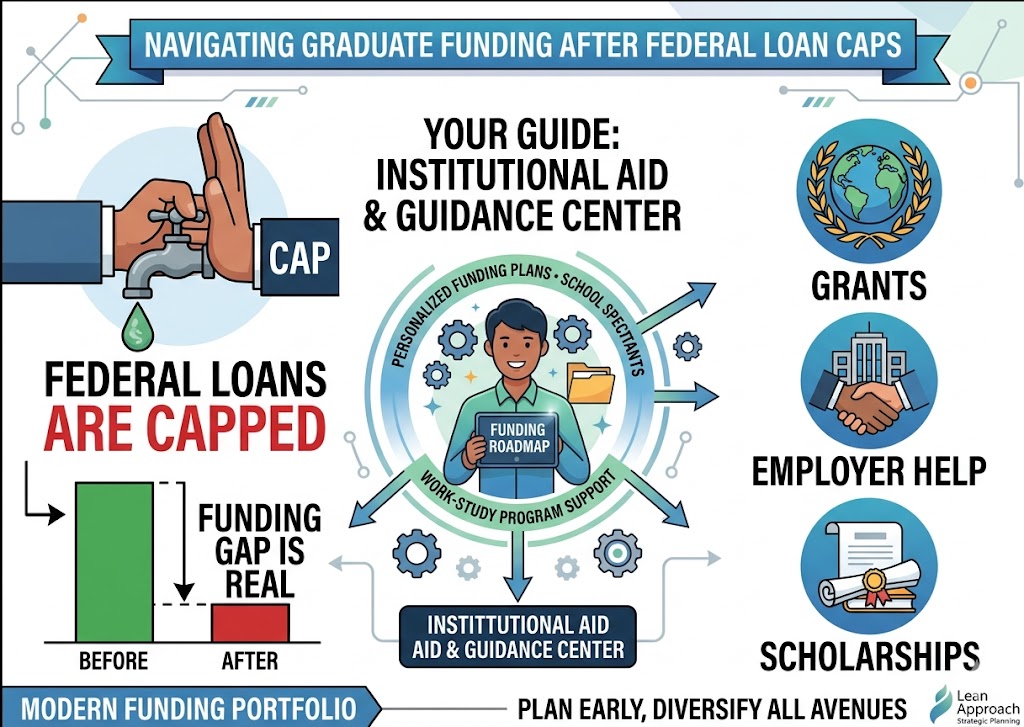
infographic of different funding methods. Newschool Financial Office can help you figure out what works for you

Navigating the 2026 Loan Caps

Pursuing a graduate degree has always been a significant investment in your future, but the roadmap for financing that journey just underwent a major renovation. The Department of Education recently finalized a landmark decision titled Reimagining and Improving Student Education, which introduces significant changes to the federal student loan program—most notably, the implementation of new caps on Graduate PLUS loans.

For years, graduate students could often borrow up to the full cost of attendance. Under the new rules, that “blank check” era is ending. While these changes aim to curb rising tuition costs and protect students from over-borrowing, they also mean that many prospective students will face a “funding gap” that federal loans alone won’t bridge.

Understanding the Impact

The shift isn’t just a minor adjustment; it’s a fundamental change in how graduate education is financed. According to recent analysis by Inside Higher Ed, these caps will most heavily impact students in high-cost professional programs. As the charts show, the distance between federal support and the actual cost of a degree is widening. This makes it more critical than ever for students to diversify their “funding portfolio.”


Expanding Your Funding Strategy

With federal limits in place, relying on a single source of capital is no longer a viable strategy. Students should explore a multi-pronged approach:

  • Institutional Scholarships & Grants: Many universities are pivoting to offer more merit-based and need-based internal aid to help offset the new federal limits.
  • External Fellowships: Look for industry-specific organizations (like the AIA for architecture students) that offer specialized grants.
  • Employer Sponsorship: Many firms are increasing their tuition reimbursement programs as a way to retain talent in a competitive market.
  • Private Financing: While federal loans offer unique protections, the private market is evolving to provide more competitive options for high-earning potential degrees.

How NewSchool of Architecture and Design Can Help

At NewSchool of Architecture and Design, we understand that these policy shifts can feel overwhelming. We believe that financial barriers shouldn’t stand in the way of design innovation and professional growth.

Our financial aid team is prepared to help you navigate this new landscape by:

  1. Personalized Financial Planning: Mapping out your specific funding gap and identifying the most “borrower-friendly” ways to fill it.
  2. Scholarship Guidance: Connecting you with institutional awards tailored to architecture, design, and digital arts students.
  3. Alternative Resource Mapping: Helping you identify external grants and work-study opportunities that align with your career goals.

The “RISE” decision marks a turning point in higher education. While the rules of the game have changed, the value of an advanced degree remains as high as ever. By starting your research early and looking beyond federal loans, you can secure the funding you need to build your future.

Ready to discuss your options? Reach out to the NewSchool of Architecture and Design financial aid office today to start building your personalized funding plan.

Fred Besançon

Fred Besancon smiling in a field at sunset

Fred Besançon, RA, RLA, LEED AP BD+C, SITES AP

Education:


About Fred

Fred is a licensed architect and landscape architect born in Santa Barbara. At NSAD, Fred integrates both sides of his professional background by teaching ways to incorporate innovative site and urban design into architecture. He has taught 2nd-year, 5th-year, and vertical undergraduate design studios; environmental science; introduction to landscape architecture; landscape graphics; landscape construction; landscape design; and served as a thesis advisor. Fred continues to learn, taking college classes and attending workshops on topics including sustainability, stormwater systems, ecology, horticulture, and ethnobotany, while contributing chapters to Routledge academic publications.

Fred worked for over eight years for architecture firms on award-winning and published projects, including custom homes, multi-family housing, government offices, zoo exhibits, and dotcom interior spaces. After working in architecture, Fred earned a master’s degree in landscape architecture at RISD and the Sheridan Center’s Certificate in Reflective Teaching at Brown University to prepare for teaching. Fred was awarded a graduate program Award of Excellence and his department’s travel fellowship. His Berlin Wall Memorial student proposal won the American Society of Landscape Architects’ Award of Excellence – its highest student design award. After RISD, Fred won a competition reimagining San Diego’s Horton Plaza Park. His entry for the Sandy Hook Elementary School Memorial was selected as a semifinalist.

Fred worked at Spurlock Landscape Architects as a senior associate on award-winning projects, including housing, corporate campuses, community spaces, university planning, university landscapes, and botanical gardens. Just before the pandemic, Fred started his own company, Connected Studio, where he explores how to design memorable places where people can connect with one another, their community, and the local ecology. Projects include landscape designs for homes, apartments, corporate campuses, public schools, and cultural landscapes across California and Arizona.

Outside of teaching, Fred enjoys spending time with his wife and two sons, gardening, astronomy, and exploring the world around him.

Waldron Adebrah

Waldron Adebrah, wearing a white hard hat and smiling, surrounded by flynig papers

Waldron Adebrah’s path into construction management began with a strong foundation in architecture, where her passion for design and creating meaningful spaces first took shape. What started as an appreciation for form and concept gradually grew into a deeper curiosity about how those ideas are realized in the built environment. Wanting to strengthen her foundation, stay aligned with emerging industry trends, and discover more efficient ways of working, she found herself drawn toward construction management, where design and execution meet.

Her journey to NewSchool was influenced by both inspiration and intention. Introduced to the program through her boss, an alumn of the Master’s in Architecture program, she was struck by how highly he spoke of his experience and the role it played in shaping his professional growth. That recommendation, paired with her own desire to expand beyond design, made NewSchool a natural next step. As an international student, she also embraced the opportunity to gain a new perspective, both academically and within the industry.

Throughout her studies, Waldron’s perspective on projects has evolved in meaningful ways. She has come to understand that successful design extends far beyond aesthetics, requiring careful consideration of feasibility, efficiency, and long-term performance. Her exposure to cost control and project delivery systems has been particularly impactful, while her growing interest in value engineering reflects her ability to think critically and creatively at the same time. For her, it is not just about achieving a vision, but about doing so in a way that is thoughtful, efficient, and grounded in real-world constraints.

Looking ahead, Waldron hopes to apply her knowledge to projects that bridge design, construction, and innovation. She is especially interested in working in tropical and developing environments, where well-considered solutions can have a lasting and meaningful impact. Her goal is to contribute to spaces that are not only visually compelling, but also practical, buildable, and sustainable, while integrating modern technology to enhance how projects are delivered and experienced.

Cesar Tran

Cesar Tran, smiling with crossed arm showing tattoos and a black polo

Alumn Cesar Tran is an architectural designer with professional experience spanning education, healthcare, and federal projects across Southern California. He is currently advancing toward architectural licensure and serves as a co-lead for the Sustainability Action Plan at Architects Mosher Drew, where he contributes to firm-wide initiatives focused on environmental responsibility and long-term design performance. 

Cesar’s commitment to the profession extends beyond practice through his active involvement in mentorship and leadership. He serves as Vice President of the Alumni Board of Directors for NewSchool of Architecture and Design and is an ACE Mentor, where he supports and guides high school students exploring careers in architecture, construction, and engineering. He earned his Master of Architecture (4+3) from NewSchool of Architecture and Design in 2022. 

Grounded in a human-centered design approach, Cesar has also applied his architectural training to the technology sector, contributing to product development for early-stage web and mobile application startups through user experience and interface design. He aspires to continue expanding his skills across adjacent design disciplines, including product design, to gain a deeper understanding of how the built environment and everyday objects are conceived and realized. 

Outside of his professional pursuits, Cesar enjoys traveling to study diverse built environments, staying active, and engaging in creative hobbies that further broaden his perspective as a designer. 

A New Milestone: NewSchool Recognized as an “Opportunity College”

Laptop screen showing Carnegie's email announcing the recognition

NewSchool of Architecture & Design Was Recognized as an “Opportunity College” by the 2025 Carnegie Classifications

We are thrilled to share a landmark achievement for the NewSchool of Architecture and Design community.

In spring 2025, the Carnegie Foundation for the Advancement of Teaching and the American Council on Education (ACE) released the much-anticipated 2025 Carnegie Classifications. This updated framework introduced a groundbreaking new metric: the Student Access and Earnings Classification.

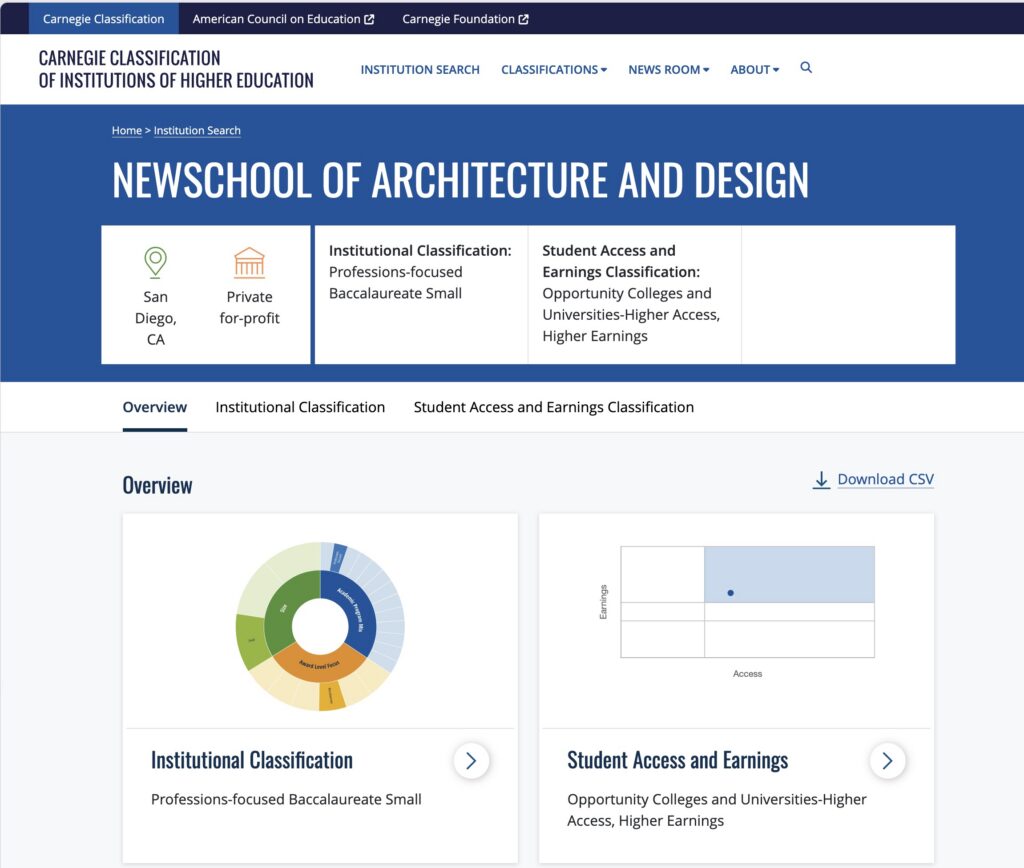
We are incredibly proud to announce that as part of this release, NewSchool of Architecture & Design has been officially classified in the top tier of this new system: Higher Access, Higher Earnings—a designation officially known as an Opportunity College and University.

Carnegie Website showing NewSchool classification
NewSchool’s page on Carnegie’s website

What Does This Classification Mean?

For decades, the Carnegie Classifications have been the leading framework for categorizing colleges and universities in the United States. The new Student Access and Earnings Classification was designed to recognize institutions that are true engines of social and economic mobility.

To earn the “Opportunity College” designation, an institution must excel in two key areas:

  • Higher Access: Enrolling a student population that is representative of and reflects the diverse communities the institution serves.
  • Higher Earnings: Ensuring that after students leave the institution, they go on to earn competitive, wealth-generating wages compared to peers in their job market.

Being named an Opportunity College is a powerful affirmation of our core mission. It proves by the numbers what we see every day in our studios and classrooms: NewSchool is not just an accessible place to learn; it is a springboard for thriving, lucrative careers in architecture, design, and beyond.


Unveiling Our New Seal

To commemorate this milestone, the Carnegie Foundation has provided recognized institutions with official branding to celebrate their impact.

Today, we are incredibly proud to share the newly designed official seal for our Opportunity College and University classification.

Whenever you see this seal on our website, campus materials, or alumni network, let it serve as a reminder of our collective commitment to student success, equity, and post-graduation prosperity. This recognition belongs to our dedicated faculty, our hardworking staff, and most importantly, our brilliant students and alumni who go out and shape the world.

Thank you for being a part of the NewSchool journey. Here is to continuing to build a brighter, more accessible future together!

Service Jam is this weekend!

On March 13th – 15th, San Diego will host its third Service Jam! NewSchool is honored to host the opening night of San Diego Service Jam: a weekend of service design to research, ideate, prototype & solve real problems to develop a solution in 48 hours.

Tickets are still available on EventBrite, including few discounted student tickets.

What is the Service Jam?

A weekend of doing: listening to real people share their challenges, exploring solutions that meet real needs, and prototyping to develop a solution in 48 hours.

The Jam includes practitioner “flash talks” from notable design thinkers along with tactical coaching and mentorship from practitioners. Tiziana d’Agostino, assistant professor in the school of Design will be giving a Flash Talk on Friday night.

What makes SD Service Jam special isn’t just the process: it’s the people, the play, and the practice. Participants don’t sit through talks. They learn by building, testing, and sharing together, supported by local practitioners who believe design should be accessible, human, and joyful.

San Diego Service Jam is part of the Global Service Jam, a worldwide movement that brings together designers, educators, technologists, and community members to solve meaningful problems through service design.

Both newbies and experts are welcome. You’ll walk away with new tools for your service design toolkit, share a few scrumptious meals with new friends, and create solid service prototype with a team of fellow designers.

The Architecture of Dignity: How One Alumnus is Reshaping Housing for the Homeless

The colorful and stylish tiny houses of Community First! Village

In a world where architecture often competes for skyline dominance, some of the most impactful designs are happening at a much smaller scale—closer to the ground and closer to the heart. A recent feature in Architect Magazine, titled: The Architecture of Dignity: How Six New Microhomes Are Expanding Austin’s Community First! Village, shines a spotlight on this shift, and we are proud to see NewSchool of Architecture and Design alumnus Mark Odom at the center of it.

Designing for “Neighborhoods of Knowingness”

Mark Odom, founder of the award-winning Mark Odom Studio, has partnered with the nonprofit Mobile Loaves & Fishes to expand Austin’s Community First! Village—a 178-acre master-planned community that provides affordable, permanent housing for men and women coming out of chronic homelessness.

The article details how Odom’s firm didn’t just shrink traditional homes; they reimagined the typology of housing to prioritize mental well-being and community connection. The studio developed six distinct microhome designs, ranging from 144 to 200 square feet. These homes are categorized into two families: those designed for extroverts who crave social interaction (featuring open porches and clear sightlines) and those for introverts needing a personal refuge (prioritizing privacy and sheltering overhangs).

A modern tiny home in the project

More Than a Shelter

What makes this project standout is the concept of “Neighborhoods of Knowingness.” As the article explains, Odom’s design moves beyond the individual unit to shape the layout of the broader site. Instead of rigid grids, the homes are clustered around shared common spaces and meandering paths. This intentional choreography encourages daily contact and strengthens social ties—crucial factors in preventing a return to homelessness.

“It was an incredible experience and honor to develop the new microhomes for Community First!,” Odom noted in the piece. His work proves that constraints on budget and size often lead to the most empathetic and innovative design solutions.

A Legacy of Service

At NewSchool of Architecture and Design, we encourage our students to use their skills to address real-world challenges. Mark Odom’s work at the Community First! Village is a shining example of that mission in action. By balancing efficient construction with deep architectural empathy, he is helping to prove that design can be a powerful infrastructure for social change.

We invite you to read the full article in Architect Magazine to learn more about this groundbreaking model for supportive housing.

Read the full article here

All images by Andrea Calo, Architectmagazing.com

*